What to Look For Before You Choose a Dive Shop
Most dive shops in Sydney look roughly the same from the outside. They're PADI affiliated, they run courses on a calendar, and they've got gear on the wall. The differences that actually matter, the ones that decide whether you have a great first experience underwater or a frustrating one, show up once you start asking questions: how many other students will be in your group, who's actually teaching you, whether the price you're quoted is the price you pay, and what happens if the weather doesn't cooperate.
This guide runs through what to check before you book: reviews and experience, class sizes and instructor credentials, pricing, how a shop handles Sydney's conditions, and a few red flags worth knowing about. None of it takes more than a phone call or a look at a website to check, and none of it requires any special knowledge, just a handful of direct questions and a shop willing to answer them plainly. If you already know you want to learn to dive and you'd rather skip straight to it, you can get certified with us and use the checklist below to compare us against anyone else you're considering.
Check the Reviews and How Long They've Actually Been Operating
Start with the basics. A shop's review count matters more than its star rating on its own. A perfect five stars from a dozen reviews tells you a lot less than a strong average built on a thousand. Look for a genuine, sizeable body of reviews, and actually read a handful rather than just glancing at the average, since the detail in a review, how a nervous first-timer was treated, whether a class ran late, how a problem was handled, tells you more than the number does.
It's also worth checking that reviews are recent, not just numerous. A shop can pick up a strong average early on and coast on it for years, so a few reviews from the last six to twelve months tell you whether the experience is still consistent. If there are any lower-star reviews, read a couple of those too, and see how the shop responded. It's also worth checking more than one platform, Google reviews in particular, rather than relying on a curated list of testimonials on the shop's own website.
Years in operation matter as well. Diving is a skills-based activity, and a shop that's been teaching people in the same conditions for decades has seen almost everything that can come up in a beginner's first few dives.
At Dive Centre Bondi, that looks like 4.9 out of 5 from over 1,100 reviews, and we've been teaching people to dive at Bondi Beach since 1997, 29 years and counting. Whichever shop you're considering, ask for the same two numbers, and read past the star rating.
Ask About Class Sizes and Who's Actually Teaching You
Two questions matter more than almost anything else: how many people will be in your group per instructor, and who is actually running the course.
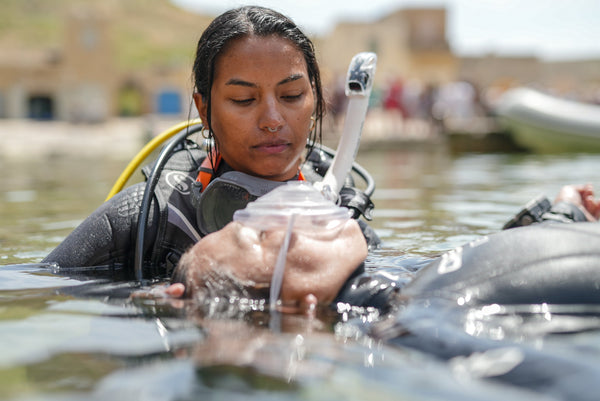
Class size determines how much individual attention you get. PADI's own maximum for open water training is 8 students per instructor, and that ratio can be raised further, up to 12, when the instructor has a certified assistant helping out. That's worth asking about directly: a shop that quotes you "small classes" might still mean a fairly full group once assistants are added in. A smaller ratio isn't just a nicety, either. Scuba skills are physical and highly individual, someone might need three attempts to master mask-clearing while another gets it first try, and the only way an instructor can give that kind of real-time correction is by not having too many other students waiting their turn. At Dive Centre Bondi, we cap classes at 5 students per instructor, specifically so nobody's left treading water while the instructor works one-on-one with someone else.
It's also worth asking how many days a course actually runs over, and how that time is used. We run the PADI Open Water course over three days rather than two. That's a deliberate choice: more time in the water, more practice on each skill, and room for people who learn at a different pace to everyone else in the group.
Then there's the instructor. Ask how experienced they are, what they're qualified to teach, and specifically who will be teaching you, not just who's listed on the website. I'm Dive Centre Bondi's in-house PADI Platinum Course Director, and I'm personally involved in training here, at a centre that's a PADI Platinum 5 Star IDC Centre, one of only two in Australia in 2026. That's not just a badge on a website: it means the same standard of training that produces PADI instructors is behind every course we run, from your first Discover Scuba dive through to Open Water.
A shop confident in its instructors will tell you exactly who's teaching you and what their background is, without you having to dig for it. If you'd like to see what that looks like in practice, you can start with our PADI Open Water course.
Find Out What's Included, and Get the Price Before You Book
Ask exactly what's included in the price you're quoted: is gear provided, are course materials part of it, is the certification fee separate? Get a clear, specific answer before you book, not after you've paid a deposit. A shop that's straightforward about pricing when you first ask is usually straightforward about everything else too.
It's also worth checking that the price you see online matches what you're quoted over the phone or in person. A mismatch, even a small one, is worth asking about directly rather than assuming it's an oversight. And ask about deposit and cancellation terms before you commit: how much is required upfront, what happens if your plans change, and whether it's refundable. These are ordinary, reasonable questions, and a shop worth booking with will answer them plainly rather than pointing you to fine print.
It's also worth asking whether the quoted price includes your PADI certification card once you finish, or whether that's billed separately at the end. Some shops don't mention this until your last session, by which point you're not really in a position to shop around.
Cost shouldn't be the only thing you decide on. A cheaper course that cuts corners on class size or in-water time isn't actually cheaper once you factor in what you're getting. But cost shouldn't be a mystery either. Not every shop publishes pricing online, and some prefer to quote by phone once they know what you're after, which isn't unreasonable by itself. Either way, ask what's included and what the total comes to, in writing if you can get it, so you're comparing shops on the same basis rather than guessing.
At Dive Centre Bondi, the PADI Open Water Diver course is $895, with what's included confirmed upfront rather than something you discover later. Whichever shop you're considering, ask the same two questions: what's the full price, and exactly what does that cover?
Ask How They Handle Sydney's Conditions
Sydney diving is genuinely weather and season dependent. Swell, visibility, and water temperature all shift through the year (the Sydney coastal waters forecast tracks exactly this), and any shop that's been operating here for a while knows it well. Ask what happens to your booking if conditions aren't right on the day: do they reschedule you smoothly, give you enough notice, and is a make-up session actually included, or is it left as your problem to sort out?
It's also worth asking whether a shop has more than one site it can use. Sydney has a handful of well-regarded shore and boat dive locations, each with its own character and its own sensitivity to swell, wind direction and visibility, and a shop that can move your session to a better-sheltered spot when conditions turn is generally better set up than one tied to a single location.
Ask, too, how much notice you'll typically get if a session needs to move, and whether rescheduling comes with any extra cost. A shop that handles this well usually has a clear, matter-of-fact answer, rather than a vague reassurance that it'll "get sorted out on the day."
Be wary of a shop that promises perfect conditions every time. Nobody can guarantee that in Sydney, and a shop that's upfront about the occasional bad-visibility day or a blown-out swell is more trustworthy than one that oversells consistency it can't deliver. What you want to hear is a clear, specific answer about how they actually handle it, not a vague reassurance.
Red Flags to Watch For
A few things are worth treating as a warning sign, wherever you're considering booking:
- Rental gear that's visibly worn, poorly maintained, or clearly overdue for a service, ask to see it before you commit, not just photos on a website.
- Vague or evasive answers when you ask directly about training, safety, or cost, a straight question deserves a straight answer.
- Pressure to book on the spot, rather than time to think it over and compare against somewhere else.
- No clear answer on what's included in the price, even when you ask twice.
- No straight answer on class size or who's actually teaching, when you ask directly.
- Instructor qualifications you can't find anywhere, or a shop that seems reluctant to name who's teaching you.
- Noticeably high staff turnover, or an inability to tell you who'll actually be running your course.
- A website or booking page with no mention of reviews, years in operation, or any other way to check the shop's track record.
None of these is automatically disqualifying on its own, and a shop might have a perfectly reasonable explanation for one of them on any given day. But a shop that shows more than one of these signs together is worth a second look before you hand over a deposit. A shop that's genuinely confident in what it offers will usually answer every question in this guide directly, without hesitation, and won't mind you asking any of them.
FAQ: Choosing a Dive Shop in Sydney
What should I look for when choosing a dive shop in Sydney?
Genuine reviews and years in operation, class size and who's actually teaching you, a price that's given upfront in full, and honesty about how weather and conditions are handled. A shop that answers all of this without hesitation, and without being asked twice, is a good sign.
How much does it cost to learn to dive in Sydney?
Prices vary by shop and what's included. At Dive Centre Bondi, the PADI Open Water Diver course is $895, with everything it includes confirmed before you book rather than added on as extras later.
Do I need to be a strong swimmer to start scuba diving?
No. PADI's Open Water course requires a 10-minute swim or float, and either a 200 metre continuous swim or a 300 metre swim with mask, fins and snorkel. Neither is timed. It's a comfort-in-water check, not a fitness test, and most first-timers find it easier than they expect.
How many students are usually in a scuba diving class?
PADI allows up to 8 students per instructor for open water training, rising to 12 with a certified assistant. Some shops run smaller groups; Dive Centre Bondi caps classes at 5 per instructor for more individual attention.
Why don't more dive shops publish their prices online?
Many prefer to quote over the phone once they know what you're after. It's worth asking for the full price in writing before you book either way, so you can compare properly. Dive Centre Bondi publishes its course pricing openly for exactly this reason.
Whichever shop you choose, ask the questions in this guide and expect straight answers. It's a short conversation, a handful of questions over the phone or in person, and it tells you a lot about how you'll actually be looked after once you're in the water. If you're ready to get started, you can book the PADI Open Water Diver course with us at Bondi Beach.