What Gear Do You Need for an Open Water Course?
At Dive Centre Bondi, all the scuba equipment you need is included in the course: BCD, regulator, tank, weights and a 7 to 8mm wetsuit. The only things you sort out yourself are a mask, snorkel, boots and fins. You can hire those, but we strongly recommend buying at least your own mask and snorkel before Day 1.
So you don't need to turn up to our PADI Open Water course with a car full of gear, and you don't need to spend a small fortune before you've even had your first breath underwater. The real questions are simpler: which of those four personal items should you hire, which are worth buying, and what can wait until diving is a regular thing for you. Here's the short version.
| Included in the course | Buy (recommended) or hire | Leave until you're diving regularly |
|---|---|---|
| BCD, regulator, tank, weights, 7 to 8mm wetsuit (plus a 4mm hooded vest if you feel the cold) | Mask and snorkel ($25 to hire), boots and fins ($25 to hire) | Dive computer, BCD, regulator, your own tank |
What's Included in the Course (and Why the Wetsuit Is So Thick)
You don't need to buy any scuba equipment to learn to dive with us. The course includes your BCD (the jacket that holds your tank and controls your buoyancy), regulator, tank, weights and wetsuit, along with your PADI eLearning, the pool session, four ocean dives, your certification fees, and your logbook and certification card.
The wetsuit is where people are usually surprised. We give Open Water students a 7 to 8mm suit, which is thicker than most people expect. That's because Sydney water sits at around 18°C in winter and 23°C in summer, and while 23°C sounds warm on a beach, it doesn't feel that way after a long dive. For anyone who feels the cold more than most, we also have 4mm hooded vests to wear with the wetsuit, so everyone stays warm whatever the time of year.
Staying warm isn't about comfort alone. A cold student tenses up, breathes harder and finds it hard to concentrate, which is the opposite of what you want while you're learning buoyancy and mask skills. A warm student relaxes, and relaxed students learn faster.
Everything you'll use is top-quality, continuously serviced equipment, and we service regulators, BCDs and cylinders in our own servicing workshop at the shop. You'll use it first in our heated 50m indoor pool, then on your ocean dives at Camp Cove and a second Eastern Suburbs site chosen for the day's conditions.
Mask, Snorkel, Boots and Fins: Buy or Hire?
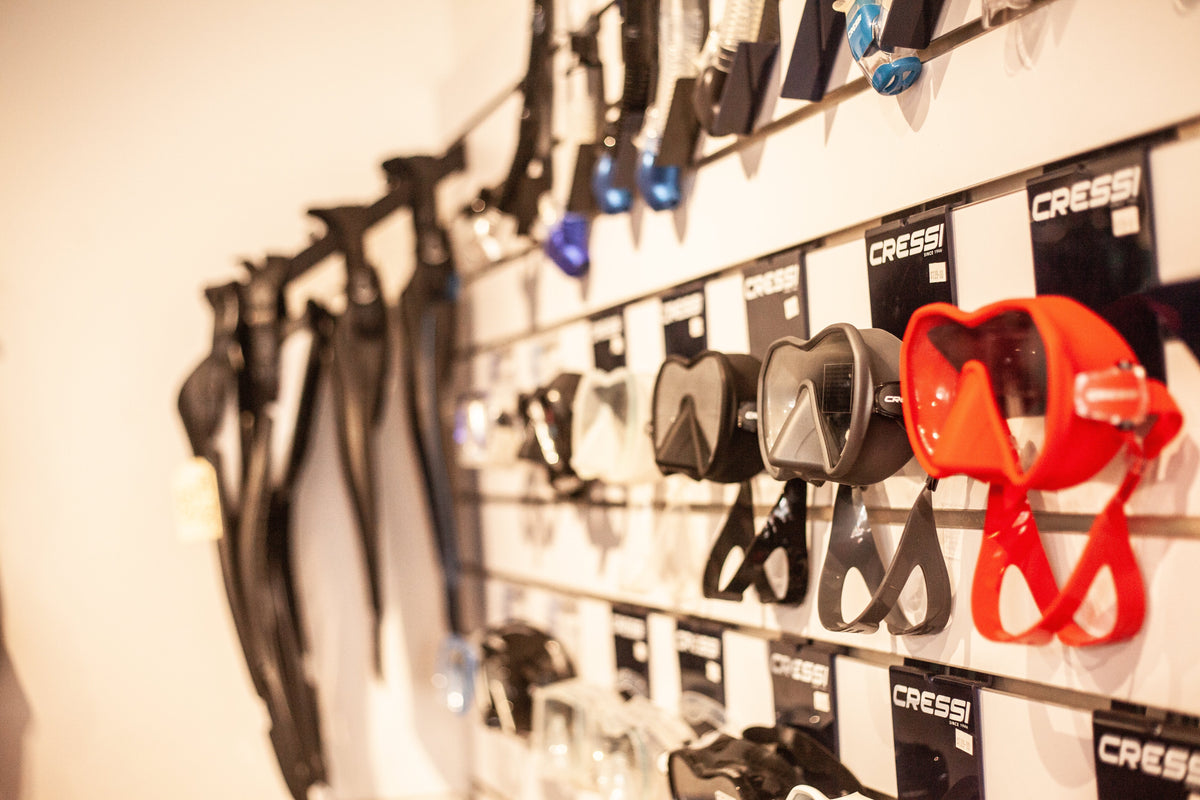
Our advice is simple: buy at least your own mask and snorkel. You can hire, and some people do, but hire masks are a set of generic masks. In our retail space we have a huge range of masks, and we're confident one of them will fit your face shape perfectly. That fit is what makes the difference in the water, and it's the same principle PADI puts first in its gear advice: fit, comfort and suitability.
Buying your own (what we recommend)
Open Water students get 10% off everything in the shop, and 20% off when you buy the full set of mask, snorkel, boots and fins. Adult mask and snorkel sets in our Bondi dive shop start from $89, and you can browse our mask and snorkel sets online before you come in.
The best thing you can do is come into the shop at 198 Bondi Road before Day 1 and try masks on. A mask that looks right online can feel completely different on your face, and with the range we carry, it only takes a few minutes with someone who fits masks every day to find the one that seals properly.
Hiring for the course
If you'd still rather hire, it costs $25 for a mask and snorkel and $25 for boots and fins. You can book hire when you book your course, or sort it out on the day. Just keep in mind that hire masks are generic, so the fit won't be as personal as a mask chosen for your face. Hiring boots and fins for the course is a perfectly reasonable choice if you're not ready to buy them yet.
Why I Always Tell Students to Start With a Mask
If you only buy one thing before your course, make it a mask and snorkel. I tell every student the same thing: a mask is very personal, and only certain masks will fit each face. Style is secondary. When a mask fits perfectly, no water runs inside, and that makes the whole course easier and a lot more enjoyable, because you can focus on learning instead of fighting a leak. It's also the easiest piece of dive gear to travel with, so it'll come on every dive holiday you take from here.
How to tell if a mask fits
- Push your hair back so none of it sits under the mask's silicone skirt.
- Hold the mask gently against your face without putting the strap on.
- Breathe in softly through your nose. A mask that fits will seal and stay on by itself.
- Check for pressure points around your nose and forehead. It should feel snug, not tight.
- When you do wear it, keep the strap loose. An overtightened strap causes more leaks than it stops.
If your new mask leaks on Day 1
If a mask you bought from us for the course leaks, we'll swap it for one that fits. You shouldn't spend your first pool session wondering whether the problem is you or the mask.
Glasses and contact lenses
Contact lenses are fine under a dive mask. If you'd rather not wear contacts, we sell prescription-lens masks in the shop. Let the team know before your course so we can sort it out in time.
If you want to go deeper on models and features, we've compared the best scuba masks this year, and you can see our full range of dive masks online. Once you've got a mask sorted, you're ready to learn to dive in Sydney.
Then Boots and Fins, and What Can Wait
After a mask and snorkel, boots and fins come next. Boots protect your feet on rocky shore entries like the ones around the Eastern Suburbs, and fins that suit your legs make every dive less tiring. If you're confident diving is going to be your new hobby, the full set of mask, snorkel, boots and fins is the best value, since that's when the 20% student discount applies. Have a look at our dive fins and dive boots to get a feel for the range.
Everything else can wait:
- Dive computer. This is usually the first bigger purchase once you're diving regularly. We've put together a guide to dive computers for beginners for when you get there.
- BCD and regulator. Keep renting these until you've dived enough to know what you like. They're the expensive items, and your preferences will change as you gain experience.
- Your own tank. Rarely worth it for most divers. Cylinders need periodic hydrostatic testing ($80 per test with us), and renting is simpler.
What to Bring on the Day
Beyond gear, here's what to pack for your course days:
- Swimwear and a towel
- Water and snacks
- A warm layer for between dives
- Your completed PADI eLearning
- Your completed PADI Diver Medical form (if anything on it applies to you, bring your doctor's sign-off)
- Your mask, snorkel, boots and fins, if you've bought them
In summer our weekend course starts on a Saturday, and the rest of the year it starts on a Sunday. Either way, you come back the following weekend for your four ocean dives.
FAQ: Gear for Your Open Water Course
Do I need to buy my own gear for the PADI Open Water course? No. At Dive Centre Bondi all scuba equipment is included: BCD, regulator, tank, weights and a 7 to 8mm wetsuit. You only need a mask, snorkel, boots and fins, which you can hire for the course or buy in our Bondi shop.
Can I hire a mask and fins for my Open Water course? Yes. A mask and snorkel is $25 to hire, and boots and fins are $25. Hire masks are generic, though, so we strongly recommend buying your own mask and snorkel from our range, where we're confident one will fit your face perfectly.
What wetsuit do I need for diving in Sydney? Sydney water is around 18°C in winter and 23°C in summer, so we use 7 to 8mm wetsuits for the Open Water course, with 4mm hooded vests for anyone who feels the cold. It's all included, so you don't need to buy a wetsuit to learn.
What happens if my new mask leaks during the course? If a mask you bought from us for the course leaks, we'll swap it for one that fits. A mask that seals properly makes learning much easier, so it's worth trying a few on in store before Day 1.
Can I dive with glasses or contact lenses? Contact lenses are fine under a dive mask. If you'd rather not wear contacts, we sell prescription-lens masks in our Bondi shop. Let the team know before your course so we can sort it out in time.
Do students get a discount on dive gear? Yes. Open Water students get 10% off everything in our Bondi shop, and 20% off when they buy a full set of mask, snorkel, boots and fins.
Ready to get started? Book the PADI Open Water Diver course and come into the shop at 198 Bondi Road beforehand to try on a mask. It's the one piece of gear that makes the biggest difference to your first dives.