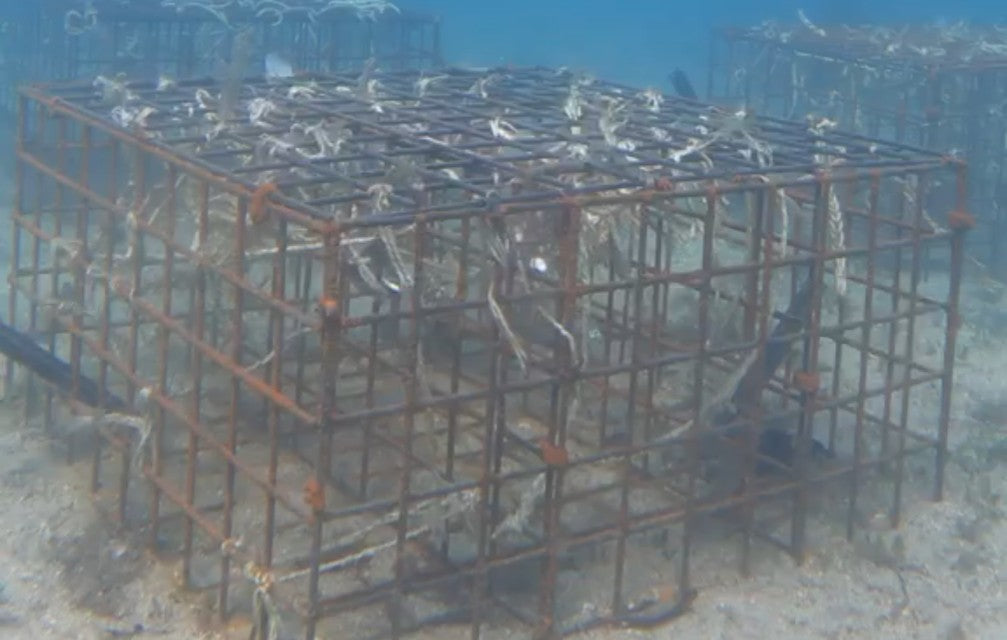
Seahorse hotels are artificial habitats that give endangered White's seahorses somewhere to shelter and hold on. They are being installed at Camp Cove in Sydney Harbour. Please look but don't touch, and share photos of any life visiting on or near the hotels on iNaturalist, with the date and location.
By Woody Lammar and Sarah Han-de-Beaux, Dive Centre Bondi
Camp Cove is where our students make their first ocean dives on the PADI Open Water course, and it is one of our favourite dive sites in Sydney. It is now also getting a set of seahorse hotels, installed to give the endangered White's seahorse (Hippocampus whitei) a safe place to live again.
The White's seahorse is a small species found only on Australia's east coast. Seahorses are remarkable animals: the male carries the eggs and gives birth, and pairs stay close to each other through the breeding season.
What are seahorse hotels?
Seahorse hotels are small artificial habitats, designed to mimic fish traps, that give White's seahorses something to hold onto while natural habitat recovers. Sponges and algae grow over the structures, small animals move in to feed, and seahorses follow. Over time the structures break down as marine growth takes over, leaving natural habitat behind.
Dr David Harasti, Principal Marine Scientist with the Threatened Species and Habitats team at NSW DPI, came up with the idea. The seahorse hotel program is a partnership between NSW DPI Fisheries, the Sydney Institute of Marine Science (SIMS), UTS (including Prof. David Booth, Professor of Marine Ecology in the School of Life Sciences), Ocean Youth, the Gamay Sea Rangers and other partners. The idea has since travelled, with hotels also trialled in Gibraltar, Greece, the United States, the Philippines and Indonesia.
Why do White's seahorses need help?
They are losing their homes. The species was listed as endangered in 2020, and habitat loss is its biggest threat. Boat anchors and moorings tear up the sponges, soft corals and seagrass the seahorses shelter in. Dive Centre Bondi has seen the effect first hand, with fewer sightings at Camp Cove over the last decade.
Numbers can fall fast. A 2007 to 2008 study of the Manly swimming net recorded more than 300 White's seahorses, and numbers fell sharply from around 2012. With so much natural habitat gone, many harbour seahorses now cling to man-made structures such as swimming nets and jetty pylons.
Why Camp Cove?
The project team selected Camp Cove, and we are glad they did. In January 2025, our instructor Sarah Han-de-Beaux contacted Dr David Harasti (NSW DPI) and Mitch Brennan (SIMS) to suggest the site. Camp Cove has a long history as seahorse habitat, and the project builds on decades of seahorse research, including Prof. Amanda Vincent's work from the 1980s through to today. After the necessary permits and approvals, the first hotels have started going into the water, with more to follow.
It is a good fit for the project. Camp Cove is a sheltered, sandy site with seagrass, and it is our main training site, so our team will notice changes on the hotels quickly. This is a NSW DPI and SIMS project, and the project partners will share official updates. We will share what we see as divers.
Do seahorse hotels work?
Yes! The early evidence is encouraging. At Clifton Gardens, a 2022 study by Harasti, Brennan and Booth found that 20 percent of captive-bred seahorses released onto hotels were still there after 12 months, compared with 2 percent of those released onto a swimming net. At Cobblers Beach, UNSW reported 12 White's seahorses living on 15 hotels in early 2025, including several juveniles likely born on site. Seahorses moved into those hotels within roughly three to six months.
Camp Cove's hotels are brand new, so we cannot promise a sighting. The sponges and algae need time to grow first. SIMS will decide if and when captive-bred seahorses are released here. If they are, the released seahorses carry small coloured markings under the skin, so they can be told apart from wild seahorses, which is why your photos will be so important for tracking them.
How you can help
Looking after the hotels takes a few simple habits, whether you dive, snorkel or boat.
- Look, don't touch. Never touch or move a seahorse, and never disturb one for a photo.
- Control your buoyancy. Stay off the hotels and the seagrass. A fin kick in the wrong spot can undo months of growth.
- Share your photos and videos. Upload photos of any life visiting on or near the hotels to iNaturalist, with the date and location, so progress can be tracked over time. A dedicated Camp Cove project is planned with SIMS. If you are lucky enough to spot a seahorse, we want to see it.
- Boaters, protect the seabed. Avoid dropping anchor over seagrass and reef, and use public moorings where you can.
See Camp Cove for yourself
If you have never dived, a Discover Scuba session is a good first step, and no experience is needed. If you want to dive Camp Cove regularly, learn to dive in Sydney with us. It is one of the easiest ocean sites in Sydney, and our guide to Sydney's top shore dives explains why. Certified divers can ask the team in the shop about a guided shore dive, where the site is chosen on the day based on conditions.
Want to give something back? Camp Cove is our adopted dive site, and our Dive Against Debris clean-up dives help keep it healthy. If you are curious about the marine life that shares these reefs, read about Sydney's sponge gardens.
This project shows what happens when divers build relationships with the scientists and government officials who protect our marine world: an idea becomes real change. Get certified with us and help us keep an eye on Camp Cove's newest residents.

About the co-author: Sarah Han-de-Beaux
Sarah is a PADI Instructor at Dive Centre Bondi, a GUE diver, a Molchanovs freediver and an underwater photographer. She is also a shark researcher and conservationist, and looks after Spot A Shark, the community-science program that identifies individual grey nurse sharks from divers' photos along Australia's east coast. Sarah is the instructor who first suggested Camp Cove to the seahorse hotel team, and she is one of the people you may meet in the water there.
FAQ: Seahorse Hotels at Camp Cove
What is a seahorse hotel?
A seahorse hotel is an artificial habitat placed on the seabed, designed to mimic a fish trap. Sponges and algae grow over it, small animals move in, and White's seahorses use it to hold on, shelter and breed while natural habitat recovers.
Are there seahorses at Camp Cove now?
Sightings are never guaranteed. The Camp Cove hotels are new and need time for sponges and algae to grow, so we are watching to see what arrives and will share what we see.
Can I touch a seahorse or move it for a photo?
No. Look but don't touch, and never disturb a seahorse for a photo. Keep your fins clear of the hotels and the seagrass, because one fin kick in the wrong spot can undo months of growth.
How deep is Camp Cove?
Camp Cove is a sheltered shore dive about 5 to 10 metres deep, with a sand and seagrass bottom. Visibility and conditions change with the weather, so check with our team before you go.
How do I report a seahorse sighting?
Photograph the seahorse or the growth on the hotels without touching anything, then upload it to iNaturalist with the date and location so researchers can track progress over time. You can also tell our team in the shop.
Sources
- NSW DPIRD: White's seahorse
- NSW DPIRD: Posidonia australis (endangered populations)
- NSW DPIRD: Current projects on White's seahorse
- Harasti, Brennan & Booth (2022), Frontiers in Marine Science
- UNSW Sydney: From check-in to baby boom (July 2025)
- Sydney Institute of Marine Science: The Sydney Seahorse Project
- Divernet: White's Seahorses in Sydney Harbour (Feb 2026)
- iNaturalist