The PADI Rescue Diver course teaches you to prevent and deal with problems underwater, big or small. Those problems can happen to you or to another diver, and at the surface or underwater, and over two days you learn to handle all of them. Most people who finish our PADI Rescue Diver course call it the biggest confidence boost they've had in diving, because afterwards they know what to do if something goes wrong.
This post covers how hard the course is, what you learn, how the two days run, what you need before you start, and what it costs.
Is the Rescue Diver Course Hard?
Most divers find Rescue the most demanding of the recreational courses, physically and mentally. It's also the one they enjoy most, because every skill is taught and practised step by step before you have to use it in a scenario.
The hard part is new for most people: you're looking after someone else as well as yourself. You'll tow a diver at the surface, bring a diver up from the bottom and make decisions while things are happening. Some of it is tiring, and the scenarios are meant to make you think under a bit of pressure.
What keeps it manageable is the way it's taught. Your instructor demonstrates each skill, you practise it until it feels comfortable, and only then do you put the skills together. We cap the course at five students per instructor, where PADI allows eight, so you get coached on every exercise and nobody gets left behind.
By the end, most divers dive more relaxed, not less. You stop hoping nothing goes wrong and start knowing what you'd do if it did. If that's the kind of diver you want to be, our Rescue course runs over two days.
What You Learn: You or Your Buddy, at the Surface or Underwater
Every problem in diving happens either to you or to another diver, and either at the surface or underwater. The Rescue course covers all four, and that's the easiest way to picture what you learn.
| At the surface | Underwater | |
|---|---|---|
| You | Getting yourself comfortable and buoyant when you're tired, cramping or short of breath | Sorting out your own problems calmly, such as a free-flowing regulator, a tangle or losing your buddy |
| Your buddy | Helping a tired or panicked diver, towing them to the exit, giving rescue breaths in the water | Recognising a diver in trouble, helping a responsive diver up, and bringing an unresponsive diver to the surface |
Alongside those four, you learn how to:
- spot the signs of stress in another diver before it turns into panic
- search for a missing diver using compass navigation
- use emergency equipment, such as a surface marker buoy
- give first aid in a dive emergency and organise help on the shore
Most of the course is about prevention: noticing small problems early, so they get sorted out long before anyone needs rescuing.
How the Two Days Run
You do the PADI eLearning at home first, so the theory is done before you arrive. The course then runs over two days, from 8am to 5pm each day. Day 1 is for learning the skills. Day 2 is for using them.
Day 1: the ten Rescue exercises
On Day 1 you work through the ten Rescue exercises, one at a time, until each one feels comfortable. They include:
- approaching a panicked diver at the surface
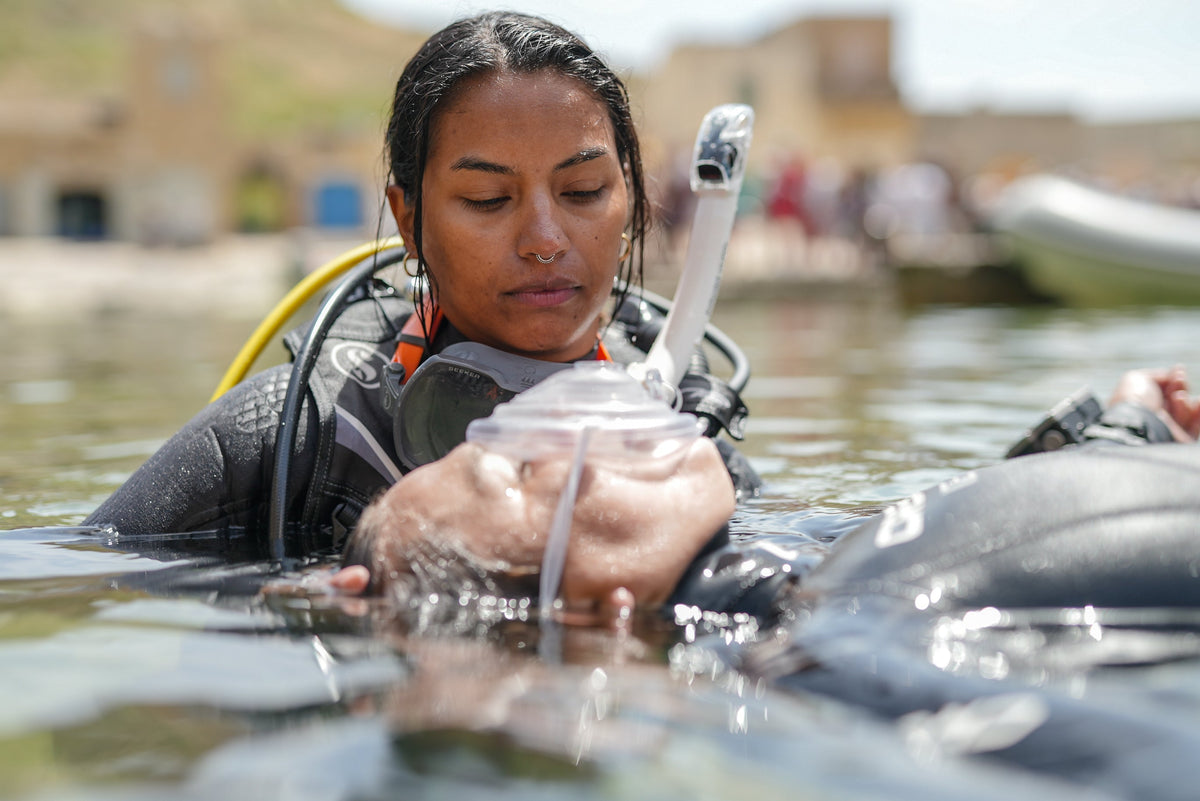
- rescuing a panicked diver at the surface
- helping a panicked diver underwater
- bringing an unresponsive diver up to the surface from below
Your instructor demonstrates each exercise first, then you practise it with your buddy until you've got it.
Day 2: realistic rescue scenarios
On Day 2 we pick up the intensity. You keep practising what you learnt the day before, but now inside rescue scenarios that we make as realistic as possible. You work out what's happening and deal with it from start to finish, the way you would on a real dive.
You'll also search for a missing diver, working together as a team and using the search patterns you've just learnt.
Why we train at Malabar
We usually run the course at Malabar, in Sydney's south-east. It's sheltered, it's an excellent spot for practising getting a diver out of the water, and there's enough space to run the skills and scenarios without disturbing other divers. We still confirm the site on the morning based on the swell and wind.
Expect to be tired at the end of each day and pleased with yourself at the end of the second.
What You Need Before You Start
To join the course, you need:
- PADI Advanced Open Water Diver certification, or an equivalent from another agency. PADI's minimum is Adventure Diver including the Underwater Navigation adventure dive, which every Advanced Open Water diver has completed.
- First aid and CPR training from the last 24 months. If yours has lapsed, or you've never done it, you can do our first aid course before the Rescue course.
- To be at least 15 years old. Under 18s need a parent or guardian's consent.
- A completed Diver Medical form. If anything on it applies to you, you'll need a doctor's sign-off before you get in the water.
Not Advanced yet? Our Advanced Open Water course includes a Rescue adventure dive, which gives you a first taste of these skills. This post on our Advanced Open Water adventure dives explains how the course is put together. And if you're not certified at all yet, start with our PADI Open Water course and come back to Rescue once you've got a few dives in your logbook.
What It Costs and What's Included
The PADI Rescue Diver course at Dive Centre Bondi costs $595.
| Included | Bring your own or hire |
|---|---|
| PADI eLearning | Mask and snorkel |
| Confined water training and shore dives | Boots and fins |
| Tanks, regulator, BCD and wetsuit | Surface marker buoy, spool and cutting tool |
| Transport to the dive site if you need it | |
| Your PADI Rescue Diver certification |
No gear of your own? You can hire everything in the right-hand column for $50 for the whole course: $25 for mask, snorkel, boots and fins, and $25 for the cutting tool, surface marker buoy and spool.
We've issued 863 PADI Rescue Diver certifications since 1997.
After Rescue: Divemaster and Beyond
Rescue Diver is the last recreational course before you can go professional. It's a prerequisite for the PADI Divemaster course, the first professional rating. To start Divemaster you also need to be 18, have 40 logged dives (you'll need 60 by the time you finish), medical clearance from a doctor within the last 12 months and first aid training within the last 24 months.
Rescue also counts toward PADI Master Scuba Diver, which you earn with Advanced Open Water, Rescue Diver and five PADI specialty courses.
If you're thinking further ahead, Divemaster is the first step on the full pathway to instructor, and we run every stage of it in house. Here's how to become a dive instructor in Australia, start to finish.
FAQ: PADI Rescue Diver Course
How long is the PADI Rescue Diver course? At Dive Centre Bondi it runs over two days, from 8am to 5pm each day: the ten Rescue exercises on Day 1 and realistic rescue scenarios on Day 2. You complete the PADI eLearning at home first.
How much does the Rescue Diver course cost in Sydney? The PADI Rescue Diver course at Dive Centre Bondi costs $595. That includes eLearning, tanks, regulator, BCD, wetsuit and your certification. If you need to hire the rest, it's $50 for the whole course: $25 for mask, snorkel, boots and fins, and $25 for the cutting tool, surface marker buoy and spool.
Is the Rescue Diver course hard? Most divers find it the most demanding recreational course, physically and mentally. Every skill is practised step by step before you use it in a scenario, and most divers say it's the course that built their confidence most.
Do I need first aid training for the Rescue course? Yes. You need first aid and CPR training completed within the last 24 months. If you don't have it, you can do a first aid course with Dive Centre Bondi before the Rescue course.
Can I do the Rescue course straight after Open Water? Not straight away. PADI requires Adventure Diver with the Underwater Navigation adventure dive, and Dive Centre Bondi asks for Advanced Open Water, so you'll do that course first.
Where is the Rescue course run in Sydney? Dive Centre Bondi usually runs the course at Malabar, in Sydney's south-east. It's sheltered, good for practising getting a diver out of the water, and has room to train without disturbing other divers.
What comes after the Rescue Diver course? The PADI Divemaster course, the first professional rating, which requires Rescue Diver. Rescue also counts toward PADI Master Scuba Diver, together with Advanced Open Water and five specialty courses.
You've learnt to dive, and you've learnt to dive well. Rescue is where you learn to look after the people you dive with. Book your Rescue Diver course and we'll see you on Day 1.