Which Adventure Dives Are on the Advanced Open Water Course?
Every PADI Advanced Open Water course is made up of five adventure dives, and two of them are always the same: Deep and Underwater Navigation. The other three vary from one dive centre to the next. On our PADI Advanced Open Water course in Sydney, we teach a set of five in a set order, because each dive builds a skill you'll use on the next one.
Over two days, it looks like this:
Day 1
- Peak Performance Buoyancy
- Underwater Navigation
- Rescue
Day 2
- Deep
- Delayed Surface Marker Buoy (DSMB)
Day 1 gives you control, direction and the confidence to look after yourself and your buddy. Day 2 takes you deeper and puts all of it to work at once. The rest of this post explains why each dive is there, and why they come in this order.
Why We Don't Hand You a Menu of Adventure Dives
PADI offers more than two dozen adventure dives, and plenty of dive centres let you pick any three to go with Deep and Navigation. On a holiday reef, that makes sense. You try a wreck, a night dive and some underwater photography, and you go home with good stories.
We take a different view of your first advanced course. It's the best chance you'll get to lock in the fundamentals with an instructor beside you, before you start planning dives on your own. So instead of a sampler, we built a sequence. Buoyancy comes first because every other skill depends on it. Navigation comes next because it only works once you can hold your depth. Rescue skills follow because a diver who can control their position and find their way back is ready to start looking out for someone else. Then the deep dive and the SMB dive ask you to use all of it together.
Both approaches produce certified Advanced Open Water Divers. Ours is built to produce divers who feel ready for Sydney's deeper sites afterwards, and that's the reason we teach it this way.
Day 1, Dive 1: Peak Performance Buoyancy
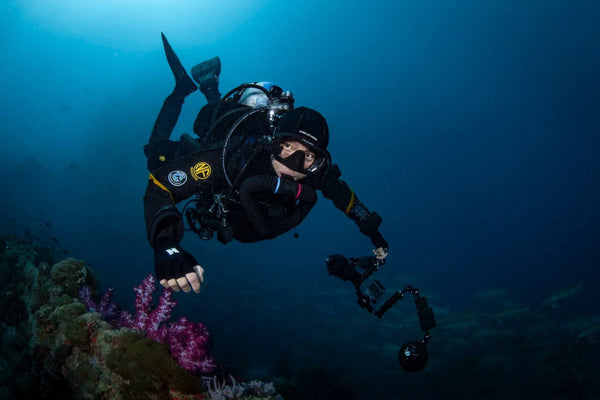
Buoyancy comes first because every other dive on the course depends on it. If you're still kicking up sand, grabbing at your inflator or finishing dives with a sore back from swimming at an angle, everything else feels harder than it should.
On this dive you work on the things that make buoyancy feel effortless: getting your weighting right, finding a flat, horizontal position in the water (divers call it trim), hovering still, and using your breathing to fine-tune your depth instead of reaching for the inflator every few seconds. Once you stop fighting the water, you'll usually find your air lasts longer too.
It matters even more in Sydney. Our reefs sit close to sand, swell moves you around in the shallows, and marine life lives right on the rocks. Good buoyancy protects the reef and makes the dive more relaxing.
It also sets up the rest of the weekend. Steady buoyancy is what lets you hold a compass heading on the next dive, manage a buddy on the rescue dive, and stay at your safety stop while you send an SMB to the surface on Day 2.
Day 1, Dive 2: Underwater Navigation
Navigation is one of the two dives every PADI Advanced Open Water course requires, and it's the dive that stops you surfacing a long swim from your exit.
You learn two ways to find your way around. Compass navigation means swimming a set heading, turning back on the reciprocal and arriving where you started. Natural navigation means using what's around you: the shape of the reef, the direction of the sand ripples, where the light is coming from. Good divers use both, all the time.
In Sydney this is a practical skill, not an exercise. Many of our best dives are shore dives, where finding your exit matters, and visibility can change from one dive to the next. Knowing how to get back to the point you planned is one of the biggest confidence boosts a newer diver can get.
There's a longer-term reason too. The Underwater Navigation adventure dive is a prerequisite for the PADI Rescue Diver course, so completing it here keeps that path open.
Day 1, Dive 3: The Rescue Adventure Dive
The Rescue adventure dive introduces you to looking after yourself and your buddy when something doesn't go to plan, which is what we think "advanced" should really mean.
Open Water teaches you to dive. It doesn't spend much time on what to do when your buddy is struggling, or on spotting the early signs of a problem before it becomes one. This dive gives you a first taste of that, in the water, with an instructor running it.
It comes third for a reason. You need good buoyancy and a sense of direction before you can pay proper attention to someone else. And it sets up Day 2, because on a deep dive you're responsible for your buddy as well as yourself.
If you enjoy it, the natural next step is our Rescue course. Here's what happens on the full Rescue Diver course, and how hard it really is.
Day 2: The Deep Dive and the DSMB Dive
The deep dive takes you into the 18 to 30 metre range under your instructor's direct supervision. It's where the buoyancy, navigation and buddy skills from Day 1 all get used at once.
A lot changes as you go deeper. You use your air faster, colours fade as the water filters out the light, and some divers notice nitrogen narcosis, a mild, temporary fuzziness that clears as you ascend. None of this is a reason to stay shallow. It's a reason to plan well, and planning is what this dive teaches: your depth, your time, your air, and how you'll come back up.
Where we do the deep dive
We choose between North Bondi, Shark Point, The Steps and Bushrangers Bay on the day, depending on the conditions. Sydney diving changes with the swell and wind, and we'd rather take you to the site that's working well that morning than stick to a plan on paper.
Sending up an SMB
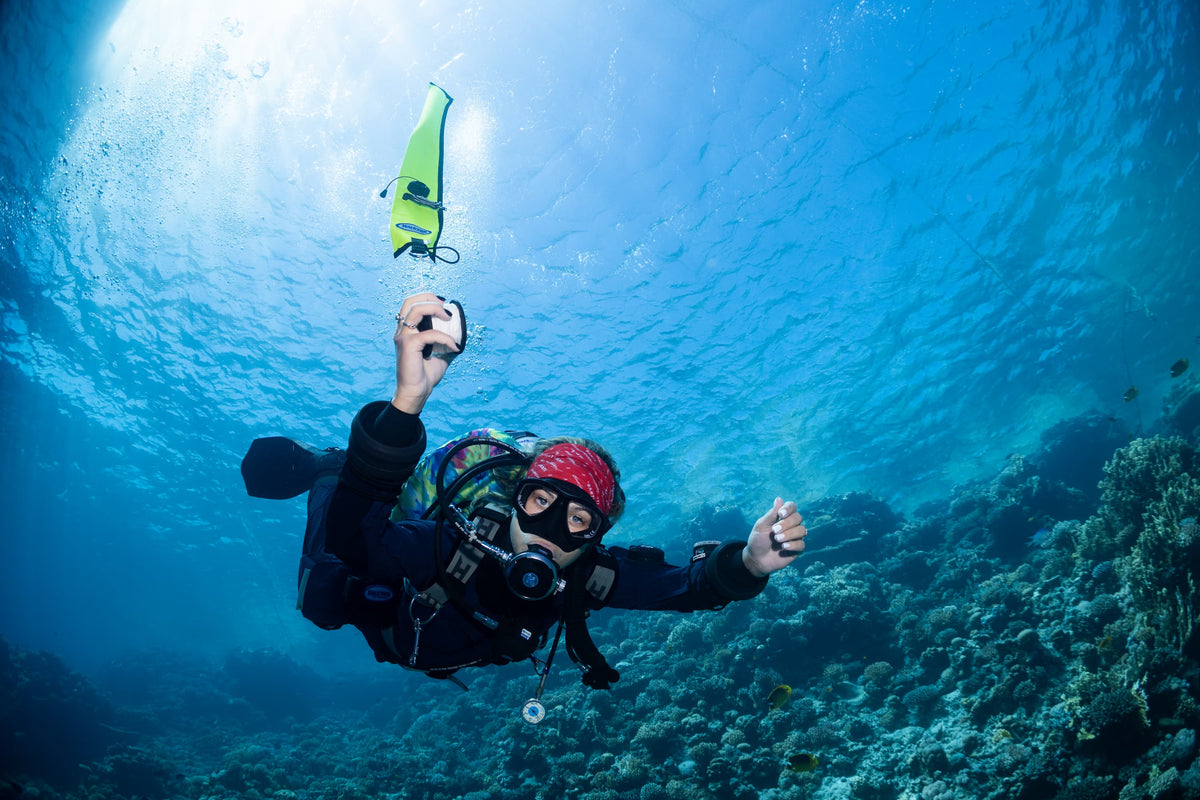
The fifth dive, the Delayed Surface Marker Buoy (DSMB) adventure dive, teaches you to deploy a surface marker buoy, or SMB: an inflatable tube you send to the surface on a line so boats and people up top know exactly where you are while you ascend and do your safety stop.
It sounds simple. Doing it well is not. You're holding your depth, managing a reel or spool, putting a controlled breath of air into the SMB and keeping it from dragging you upwards, all while ascending no faster than 18 metres a minute and stopping for three minutes at 5 metres. That's why it comes last. It's the dive where Day 1's buoyancy work pays off.
Deploying an SMB is a vital skill for any advanced diver, and it's one you'll use for the rest of your diving.
Doing it on nitrox
If you add the Enriched Air Diver course to your Advanced Open Water, you do your deep dive on nitrox. Enriched air has less nitrogen than regular air, so you absorb less of it, which gives you longer no-stop time at the same depth. In practice that means more time at the bottom. The course also teaches you to manage oxygen exposure, which comes with using nitrox. We start a little earlier on Day 2 and cover the Enriched Air theory that morning, so it's done before you get in the water. You'll find the price below.
If that's the diver you want to be, book your Advanced Open Water course and we'll see you on Day 1.
What About Night Dives and Dry Suit Diving?
They're great dives, and easier to enjoy once the core skills are solid, so we suggest adding them after the course rather than swapping them in.
- Night diving: Sydney's reefs look completely different after dark. Join one of our guided night dives once you're certified.
- Dry suit diving: if you want to keep diving comfortably through a Sydney winter, the PADI Dry Suit Diver course is the next step.
Adventure dives also count toward the matching PADI specialty, so the dives you complete on this course give you a head start if you decide to go further.
What It Costs, and the Nitrox Add-On
The PADI Advanced Open Water course costs $695 and runs over two days. We cap it at five students per instructor, where PADI allows eight in open water, so you get real coaching on every dive.
To join, you need a PADI Open Water Diver certification (or Junior Open Water Diver). The minimum age is 15, or 12 for Junior Advanced Open Water. Not certified yet? Start with our PADI Open Water course.
Add Enriched Air Nitrox for $195
When you book, you can add the PADI Enriched Air Diver course for $195 instead of the usual $295. You do your deep dive on nitrox and leave with two certifications: Advanced Open Water and Enriched Air Diver.
| Course | Price |
|---|---|
| PADI Advanced Open Water | $695 |
| PADI Advanced Open Water + Enriched Air Diver | $890 |
FAQ: Advanced Open Water Adventure Dives
Which adventure dives are required on the PADI Advanced Open Water course? Deep and Underwater Navigation are required on every PADI Advanced Open Water course. The other three adventure dives vary by dive centre. At Dive Centre Bondi, Peak Performance Buoyancy, Rescue and Delayed Surface Marker Buoy adventure dives complete the set, because each dive builds a skill used on the next.
How deep can you dive on the Advanced Open Water course? The deep adventure dive takes you into the 18 to 30 metre range under an instructor's direct supervision. Open Water training takes you to 18 metres, so Advanced is where you learn to plan and manage deeper dives.
Do I need extra dives before starting Advanced Open Water? No. You need a PADI Open Water Diver or Junior Open Water Diver certification. The minimum age is 15, or 12 for Junior Advanced Open Water.
Is Advanced Open Water harder than Open Water? Most divers find it easier. PADI's recommended course time is about 15 hours, roughly half of Open Water's 31, because you already have the basics. The focus is on building skills through five dives with an instructor.
How much does the Advanced Open Water course cost in Sydney? The PADI Advanced Open Water course at Dive Centre Bondi costs $695 and runs over two days, with a maximum of five students per instructor. You can add the Enriched Air Diver course for $195 (usually $295).
Can I dive nitrox on the Advanced Open Water course? Yes, if you add the PADI Enriched Air Diver course. At Dive Centre Bondi it's $195 with Advanced Open Water instead of $295, and you do your deep dive on nitrox, which gives you longer no-stop time at depth.
Where do you do the Advanced Open Water deep dive in Sydney? We choose between North Bondi, Shark Point, The Steps and Bushrangers Bay on the day, depending on the conditions. Your instructor picks the site that's working best for a deep dive that morning.
Does Advanced Open Water count toward the Rescue Diver course? Yes. PADI Rescue Diver requires the Underwater Navigation adventure dive, which every Advanced Open Water diver completes. Our Advanced course also includes the Rescue adventure dive, so it's a natural step into the Rescue Diver course.
You've got the card. Advanced is where you become the diver it describes, with buoyancy you don't have to think about, a way back to your exit, and an SMB you can send up at your safety stop. Book your PADI Advanced Open Water course and add Nitrox while you're at it.
📷 Header photo: Andrei Voinigescu.